You are three days into a bathroom tiling job in a new apartment in South B. The substrate is rough-cast concrete, the tiles are large-format porcelain with a marble-style finish, and the client wants the job done before the long rains hit. You reach for a bag of cement. You have done this a hundred times.
Six weeks later, the tiles start cracking, and the client tells you there are hollow sounds coming from the floors.
This guide exists to prevent that. Here is everything you need to know about tile adhesive in Kenya — what it is, which type to use, how to mix it correctly, and why the product you choose matters more than most contractors realise.
The failure is rarely in the tile. It is almost always in what was used to put it there.
MZITO Technical Team
What Is Tile Adhesive — And Why It Is Not the Same as Cement?
Tile adhesive is a polymer-modified cementitious compound engineered specifically for bonding tiles to substrates. Unlike ordinary Portland cement, tile adhesive contains additives — typically vinyl acetate or styrene-butadiene polymers — that give it flexibility, improved adhesion strength, and water resistance after curing.
In East Africa's construction sector, cement-sand mortar has historically been the default for tile fixing. It is cheap, familiar, and available. But it has real limitations — particularly for large-format porcelain tiles, wet areas, and surfaces subject to traffic and thermal movement. All of which result in higher repair costs: repeat working costs, new tiles, and new mortar.
Types of Tile Adhesive Available in Kenya, Uganda & Tanzania
Cementitious Tile Adhesive (Powder)
This is the most widely used category across Kenya. It comes as a dry powder mixed with water on site. It is suitable for most wall and floor tiling applications — ceramic, porcelain, and terracotta tiles on interior and exterior walls and floors.
Powder adhesives vary significantly in quality, performance, and technical specification. There are different grades based on technical performance such as C1, C2, C2TE where C means Cementitious. Some key differentiators:
- Open time — how long the adhesive stays workable after spreading (typically 20–40 minutes for quality products)
- Pot life — how long a mixed batch remains usable (usually 2–4 hours depending on temperature)
- Slip resistance (slump resistance) — especially important for wall tiling, where tiles must not slide before the adhesive sets
Epoxy Tile Adhesives
Two-component epoxy adhesives offer the highest chemical and water resistance. They are used in industrial environments, commercial kitchens, fast food restaurants, breweries, dairies, wineries, factories, shopping malls, meat processors, and distilleries.
| Type | Best For | MZITO Product |
|---|---|---|
| C1 Powder | Interior ceramic & porcelain walls/floors | Probond Ceramic & Porcelain (C1) |
| C2 Powder | Exterior, large-format, wet areas | Probond Ceramic & Porcelain (C2) |
| C2TE Powder | Large-format porcelain, slow-set | Probond Granite Marble & Stone |
| Epoxy | Industrial, chemical exposure, heavy traffic | Contact technical team |
How to Choose the Right Tile Adhesive
The right product depends on five factors:
- Tile type — ceramic, porcelain, natural stone, terracotta
- Substrate — concrete slab, screed, block, existing tiles
- Location — interior dry, interior wet (bathrooms/kitchens), exterior
- Exposure — traffic level, moisture, chemical contact
- Tile size — tiles above 600mm require extended-open-time (TE) adhesives and back-buttering
How to Mix Tile Adhesive Correctly
This is where most failures begin — not in the product, but in the mix.
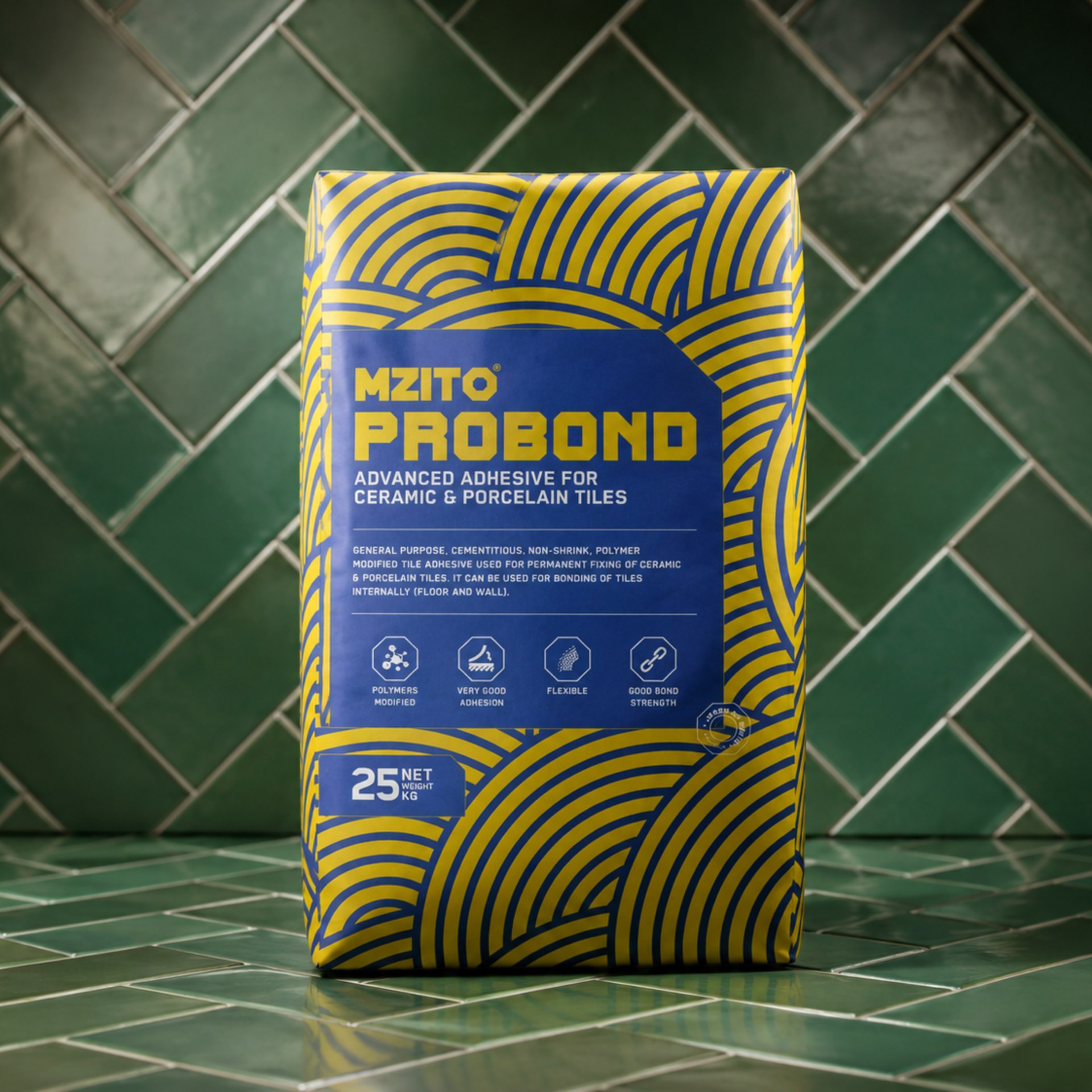
For Probond Ceramic & Porcelain: mix one 20kg bag with approximately 5.5 litres of clean water. Add the powder to the water, not water to powder. Mix mechanically with a slow-speed drill and paddle mixer until you achieve a smooth, lump-free paste. Let it slake (rest) for 5 minutes, then briefly remix before use.
Adding too much water to make the mix more workable weakens the bond dramatically. Using adhesive after pot life has expired — indicated when the mix starts to skin over or lose tackiness — causes immediate bond failure. Always follow the manufacturer's instructions for correct proportions and use clean, cool water.
Applying Tile Adhesive: The Correct Method
Spread the adhesive using a notched trowel. The notch size determines coverage:
- Standard ceramic wall tiles — 6mm notch
- Floor tiles above 300mm × 300mm — 10–12mm notch
- Large-format porcelain 600mm and above — back-butter the tile as well as the substrate
Press tiles firmly with a slight twisting motion to collapse the notch ridges and achieve full contact. Lift a tile periodically to verify 85–90% back coverage — the standard for interior dry areas, and a minimum of 95% for wet areas and large-format tiles.
Leave expansion joints every 3–4 metres and at all wall-floor junctions. This is one of the most consistently skipped steps on Kenyan sites, and it is exactly why you see cracked tiles along skirting lines in apartments that were otherwise well-built.

Tile Adhesive and Kenya's Climate: What Changes by Region
Kenya's climate is not uniform, and your adhesive choice and application method should reflect the specific conditions of your site.
- Nairobi (1,600–1,700m altitude) — cooler temperatures extend open time and slow setting. Plan grouting timing around this, especially during the June–August cold season.
- Mombasa, Dar es Salaam and the Coast — high humidity accelerates skinning. Work in smaller sections, ensure ventilation. Salt-laden air makes substrate preparation more critical — prime alkaline or salty substrates before applying adhesive.
- Rift Valley and the North — high temperatures and low humidity reduce open time significantly. Mix smaller batches, work faster, and consider early morning application during the long dry season.
- Long rains (March–May) and short rains (October–December) — avoid tiling exposed outdoor areas during heavy rainfall. Allow substrates to dry thoroughly — at least 28 days for new concrete, 14 days for screeds — before tiling.
In Mombasa, a skilled fundi works at dawn. By ten in the morning, the pot life is half of what it was at seven.
Application note — MZITO coastal guidelinesPractical Checklist Before You Start Tiling
- Substrate is clean, dry, sound, and free of dust, oil, and loose material
- New concrete has cured for a minimum of 28 days
- Substrate has been primed if highly absorbent (e.g., dry sandcrete blocks)
- Waterproofing has been applied and cured for at least 48–72 hours in all wet areas
- Correct adhesive selected for tile type and location
- Mixing water is clean — not muddy
- Notched trowel of the correct size is on site
- Expansion joint positions are marked out before tiling begins
Ready to specify the right adhesive?
Explore the full MZITO tile adhesive range — made for Africa's building conditions.